

When you are sourcing metal materials for construction platforms, industrial equipment, outdoor structures, or municipal projects, the three most frequently compared options are carbon steel, galvanized steel, and stainless steel. Many procurement teams and engineers end up making costly mistakes: some overspend on unnecessary high-grade materials, while others pick low-cost options that rust or fail within 2–3 years, leading to huge extra maintenance expenses.
1. Core Material Composition: The Fundamental Difference That Determines All Performance
The root gap between these three materials starts from their chemical makeup, not just surface treatment.
- Carbon Steel: It is the base “bare-metal” steel alloy made of iron and carbon, with carbon content ranging from 0.02% to 2.1%. It contains almost no expensive alloying elements like chromium, nickel, or molybdenum. Common grades include Q235, A36, SS400, and S235JR. This is the most widely produced, lowest-cost steel in the global metal market, with excellent ductility, weldability, and machinability.
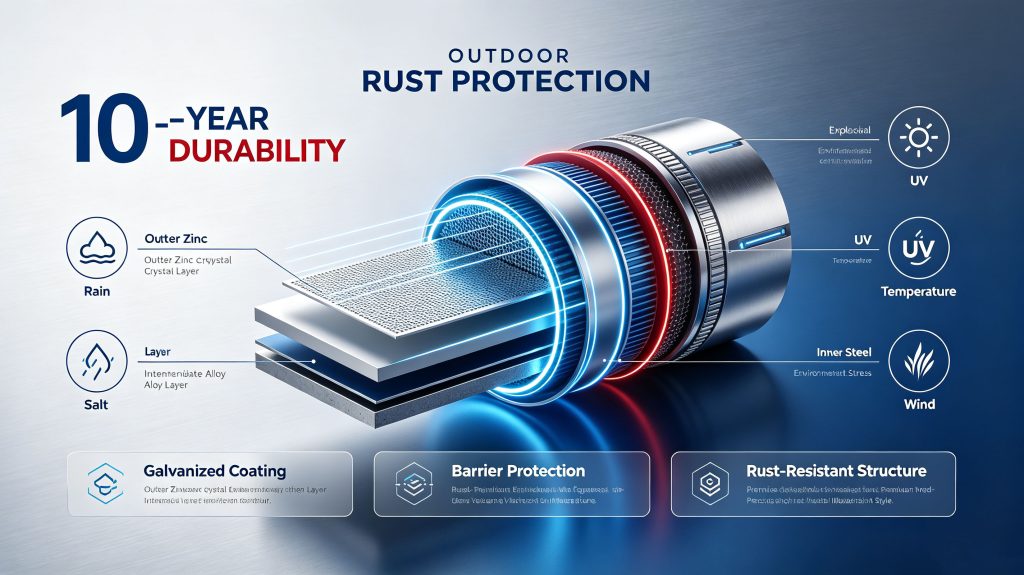
- Galvanized Steel: It is not an independent base material. It uses ordinary carbon steel as the substrate, and goes through a hot-dip galvanizing or electro-galvanizing process to form a uniform zinc coating on the entire surface. The zinc layer thickness for standard hot-dip products usually ranges from 60μm to 100μm, which provides sacrificial cathodic protection for the underlying carbon steel.
- Stainless Steel: It is a high-alloy steel with at least 10.5% chromium content added to the iron-carbon base. Common grades are 201, 304, and 316. The chromium element reacts with oxygen in the air to form a self-healing chromium oxide passive film, which blocks direct contact between the steel matrix and corrosive media. 316 stainless steel further adds molybdenum element, to greatly improve salt spray and strong acid corrosion resistance.
2. Corrosion Resistance & Service Life: Real-World Performance Data You Can Reference
Many buyers only judge “whether it will rust” by appearance, but actual engineering feedback shows that their service life varies drastically in different environments:
- In dry, indoor, non-corrosive conditions: Plain carbon steel with regular anti-rust paint can work stably for 5–8 years, with no obvious structural failure.
- In conventional outdoor atmospheric environments: Standard hot-dip galvanized steel can deliver 20–30 years of maintenance-free service life. Multiple municipal project cases in Shandong, China show that qualified hot-dip galvanized steel gratings installed on urban drainage walkways show no obvious rust or deformation after 3 years of use in rainy and dusty conditions.
- In humid, high-humidity or weak-corrosion scenarios: Galvanized steel outperforms painted carbon steel by more than 4 times in anti-rust performance, and almost no frequent repainting maintenance is required.
- In food processing, pharmaceutical workshops, or clean production scenarios: 304 stainless steel can run stably for more than 15 years, with no risk of rust shedding contaminating the production environment.
- In chemical plants, sewage treatment stations, or coastal salt-spray areas: 316 stainless steel can resist strong acid, alkali and salt erosion for decades, while ordinary galvanized steel will be completely corroded in less than 2 years.
3. Mechanical Properties, Processing Performance & Cost Comparison
For engineering projects, material selection must also consider load-bearing requirements, construction difficulty, and total budget control:
- Strength & Ductility: Low-carbon steel and galvanized steel have excellent plasticity, which is easy to bend, cut, weld and form on site. Their tensile strength can meet the load requirements of most industrial platforms, stair treads, and ditch covers. Stainless steel has higher overall strength, but its hardness is higher, so the cutting and welding processing difficulty is significantly greater than that of carbon steel.
- Thermal Conductivity: Carbon steel and galvanized steel have far better thermal conductivity than stainless steel. This is why they are the first choice for industrial heating equipment such as light-pipe radiators, which can achieve higher heat exchange efficiency and lower energy consumption.
- Cost Gap: The price of galvanized steel is only a small premium over bare carbon steel, usually 30%-50% higher. The price of 304 stainless steel is 3–5 times that of ordinary carbon steel, and 316 stainless steel is even more expensive. Choosing stainless steel for conventional non-corrosive scenarios will cause a huge waste of procurement cost.
4. Industry-Specific Selection Suggestions: Match the Right Material to Your Exact Scenario
After analyzing thousands of procurement cases across construction, manufacturing, municipal, and industrial sectors, we have summarized targeted selection rules for mainstream scenarios:
- Conventional dry workshops, warehouses, office buildings, non-humid areas: Choose ordinary Q235 carbon steel. It has the highest cost performance, excellent heat dissipation, and is very easy to customize into different sizes and structures.
- Outdoor municipal projects, greenhouse planting, aquaculture workshops, rainy and humid areas: Prioritize hot-dip galvanized steel. It requires almost no post-installation maintenance, and can maintain stable performance for decades in atmospheric exposure conditions.
- Food processing, pharmaceutical factories, precision clean workshops, scenarios with high requirements for no rust shedding: 304 stainless steel is the best choice. The smooth inner wall is not easy to scale, the medium circulation is unobstructed, and the cleanliness of the production environment is guaranteed.
- Chemical workshops, printing and dyeing factories, coastal salt-spray areas, sewage treatment stations with strong corrosive media: Select 316 stainless steel. Its excellent anti-corrosion performance can extend the service life of equipment to the full design cycle, avoiding frequent shutdown and replacement losses.
- Heavy-load industrial platforms, stair treads, ditch cover projects: You can choose hot-dip galvanized carbon steel grating with different specifications according to load requirements. For high-slip-risk areas, add a toothed anti-slip surface to further improve safety.
5. Procurement Pitfalls to Avoid
Even if you choose the correct material type, improper procurement operations will still lead to bad results:
- Do not judge the quality of galvanized steel only by the thickness of the zinc layer. Unqualified hot-dip process will lead to easy peeling of the zinc layer, which will lose the anti-corrosion effect quickly.
- Do not use 201 stainless steel instead of 304 for outdoor or humid scenarios. It is very easy to rust in rainy weather, and cannot achieve the expected anti-corrosion effect.
- Before placing an order, confirm the load requirement, corrosion grade, and installation environment parameters of the project, and ask the supplier to provide a third-party test report to ensure that the material performance meets national standards.
- For non-standard customized products, confirm the drawing parameters and production cycle with the manufacturer in advance, to avoid delaying the overall project schedule.
By matching your actual working condition with the material properties, you can avoid the two most common mistakes: overpaying for unnecessary high-grade materials, or saving a little upfront cost but paying a far higher price in later maintenance and replacement. Whether you are sourcing steel for new construction projects, equipment renovation, or municipal facility upgrading, this guide can help you make a more cost-effective, long-term reliable decision.