

“This batch of 304 stainless steel coils failed to meet corrosion resistance standards, and rust spots appeared on a coastal project after only six months.” “Excessive thickness tolerances led to a surge in the scrap rate of stamped parts.” “Delivery was agreed upon in 45 days, but it’s been two months and there’s still no shipment”—these problems are almost a common nightmare for buyers in cross-border procurement of stainless steel coils. As one of the most widely used metal materials globally, stainless steel coils are used in various fields such as building curtain walls, home appliance manufacturing, and chemical equipment. However, the hidden risks in the procurement process often cost companies dearly.
China, as a major global producer and exporter of stainless steel, exported a total of 4.5462 million tons from January to November 2025, with demand continuing to rise in markets such as Southeast Asia, the EU, and Russia. However, behind this huge market, buyers face numerous dilemmas: differences in standards between countries, confusion regarding material grades, and the uneven quality of suppliers complicate seemingly simple procurement decisions. In fact, the core of choosing the right stainless steel coils lies in solving three key issues: material matching, controllable precision, and stable delivery.
If you choose the wrong material, everything else is just empty talk.
When purchasing stainless steel coils, “material” is always the primary consideration. Different applications have vastly different requirements for the corrosion resistance, strength, and processing performance of stainless steel: coastal buildings require 316L material to resist salt spray corrosion, appliance casings favor 304 soft coils for easy stamping, and industrial equipment requires high-strength hot-rolled stainless steel coils. However, the market is rife with substandard products—using 201 material to imitate 304, or reducing chromium and nickel content to lower costs. These “hidden defects” often only become apparent after use.
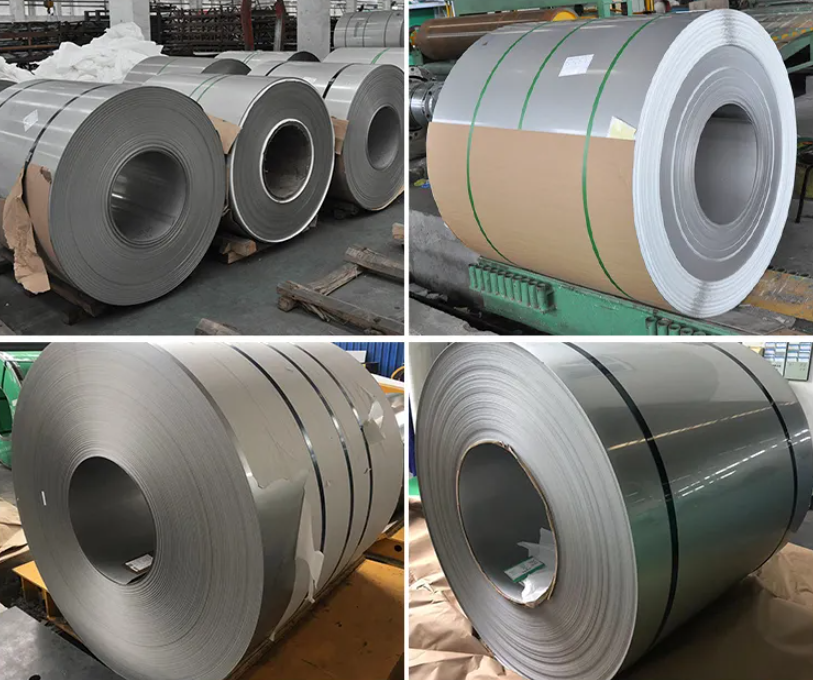
Professional suppliers provide complete Material Certificates (MTCs), clearly indicating the content of key elements such as chromium, nickel, and molybdenum, and strictly adhering to international standards such as Chinese national standards (GB), American standards (ASTM), or European standards (EN). For example, 304 stainless steel coils have a classic ratio of 18% chromium and 8% nickel, ensuring stability in most environments; while 316L, with the addition of molybdenum to 304, offers 50% improved corrosion resistance, making it the preferred choice for chemical and marine engineering applications. When procuring materials, it is essential to require suppliers to provide third-party testing reports. Verify the authenticity of the materials through data such as spectral composition analysis and salt spray testing to avoid project delays due to material issues.
Precision control: Invisible tolerances, visible costs
“Why can one company produce precisely formed 1.2mm thick stainless steel coils, while another frequently encounters problems?” The answer lies in “tolerance control.” In precision machining scenarios, every 0.05mm exceedance in thickness tolerance can lead to bending cracks, uneven stretching, and directly increase processing loss rates. One home appliance company once experienced a 15% reduction in material utilization and a single batch loss exceeding $100,000 due to excessive width tolerances in the stainless steel coils it purchased.
The precision control of high-quality stainless steel coils is reflected in the details: the thickness tolerance of cold-rolled coils can be controlled within ±0.02mm, the width deviation within ±1mm, and the surface is free of defects such as scratches, pitting, and oxide scale. Choosing the appropriate process type based on processing requirements is also crucial: cold-rolled coils have a smooth surface and high precision, suitable for home appliances, decoration, and other fields; hot-rolled coils have high strength and good toughness, and are mostly used in industrial equipment and infrastructure projects. In addition, whether the supplier provides customized services such as slitting, leveling, and cutting will directly affect production efficiency – precise matching of dimensions can reduce cutting waste and increase material utilization to over 95%.
Delivery and Service: A Reassuring Factor for Cross-Border Procurement
In cross-border procurement, delivery delays are the most common pain point. Traditional trade shows or B2B platform procurement often lead to extended delivery times due to excessive intermediaries and poor communication. However, the independent website direct sourcing model is changing this situation. By establishing their own brand presence, suppliers can directly connect with buyers, reducing intermediaries, and leveraging digital management to achieve real-time production progress tracking.
Reliable suppliers will clearly commit to delivery cycles: the standard production cycle for 304 and 316 stainless steel coils is 25-35 days, supporting multiple trade terms such as FOB and CIF. Packaging uses moisture-proof paper, rust-proof film, and reinforced wooden frames to prevent moisture damage, deformation, and scratches during transportation. More importantly, they offer comprehensive after-sales support—responding within 48 hours to provide returns, exchanges, or replacements in case of quality issues. A stainless steel company in Foshan achieved stable delivery of orders worth $550,000 through the independent website direct sourcing model and established long-term agency partnerships with clients, precisely because of this advantage of “guaranteed delivery and comprehensive service.”
Three practical tips for purchasing stainless steel coils
Define specific application requirements: Select materials and hardness levels based on the usage environment (e.g., exposure to acids, alkalis, salt spray) and processing technology (stamping, bending, welding) to avoid over-purchasing or insufficient performance.
Identify core parameters: Clearly specify material grade, thickness/width tolerances, and surface treatment methods (2B, BA, brushed, etc.) in the contract, and require a test report to be included with the goods.
Choose direct sourcing channels: Prioritize source factories with independent websites. This allows for more competitive pricing and direct access to technical teams to address customized needs and after-sales issues.
In today’s increasingly competitive global stainless steel market, the core of procurement is no longer simply comparing prices, but finding partners with “reliable quality, rapid response, and professional service.” Choosing the right stainless steel coils not only reduces production costs and improves product quality but also lays a solid foundation for the company’s international development. After all, in the face of project delays and product recalls, a correct procurement decision is the most worthwhile investment.